
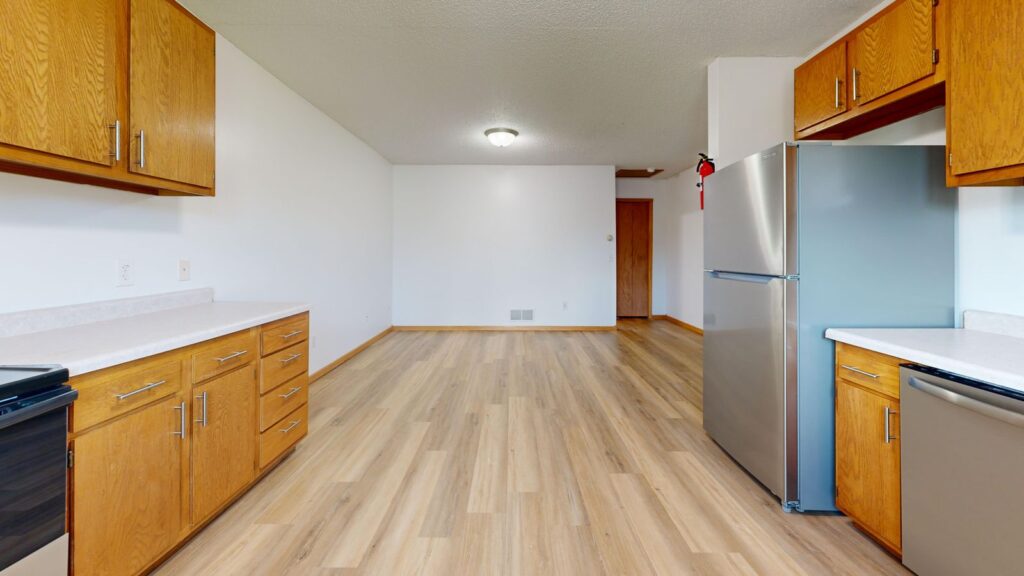
Dated is not the same as unusable. I watch buyers walk out of good houses over oak cabinets and a laminate countertop, and I watch other buyers fall in love with a kitchen that photographs beautifully and functions terribly. Both of those are the same mistake. You’re judging the finish instead of the function.
If you’re looking at homes in Syracuse, Unadilla, Palmyra, Weeping Water, Louisville, Murdock, Elmwood, or Bennet, you are going to see older kitchens. A lot of these houses have been lived in by the same family for decades. The kitchen still works. It just hasn’t been restyled since it was built. That’s a different problem than a kitchen that can’t hold your groceries or fit two people at once.
Separate what you need from what you want
Before you tour anything, write down two lists. Keep them apart.
Daily function needs are the things that decide whether you’ll be irritated every single night. Counter space next to the stove. A place to set a hot pan. Room to open the dishwasher and still get to the fridge. Storage for the things you actually use.
Cosmetic wishes are cabinet color, backsplash, hardware, flooring, light fixtures. These matter. They just don’t matter the same way. A cosmetic issue is something you can look at for two years and then change when you’re ready. A function issue is something you live inside every day.
Most buyers blur those two lists together and then can’t explain why they’re saying no to everything. Keep them separate and your showings get a lot more useful.
Four things to actually look at
Workspace
Stand where you’d chop. Is there a real run of counter, or is it broken into three short stretches by a sink and a range? Where would the groceries land when you come in the door? If you bake or can or cook for a crowd, you need continuous surface, not total square footage.
Storage
Open the cabinets. Look at depth, not just door count. Deep lower cabinets with no pull-outs swallow things. Check for a pantry, and if there isn’t one, look for where one could go. In a lot of older small-town houses there’s a basement stairwell or a back entry doing pantry duty already, and that works fine once you know it’s the plan.
Layout
Walk the path from fridge to sink to stove. Then imagine someone else in the room. Kitchens from certain eras were built for one cook, and if your household cooks together, you’ll feel that immediately. Also notice where the kitchen sits relative to everything else. Some older layouts close the kitchen off completely. That’s not good or bad. It’s just something you should decide on before you’re living in it.
Maintenance
This is the part people skip. Look under the sink for stains and soft spots. Check whether the flooring is lifting at seams. Look at how many outlets there are and where. Ask about the age of the appliances and whether anything has been replaced. An ugly kitchen with sound plumbing and solid cabinet boxes is in better shape than a nice-looking kitchen sitting on a slow leak.
What this means for your offer
I’m not going to tell you what any of this costs or what it returns. Nobody can tell you that honestly at a showing, and anyone who does is guessing. What I will tell you is that condition is a negotiating conversation, and it belongs in the plan.
I had buyers leaving a Lincoln starter home for a place out east that needed work. They weren’t going to just throw full price at it. We went in at a number that made sense for the condition and we kept pushing. The sellers said no more than once. We stayed patient and eventually got what mattered most negotiated in. At the same time, we had their Lincoln house prepped, listed, and under contract so the timing on both sides actually worked. On paper that sounds simple. It wasn’t.
If you’re selling and buying at once, condition matters even more, because every dollar you commit to a kitchen is a dollar not sitting in your buffer after closing. That’s a timing question as much as a taste question. It belongs in the game plan from day one, not after you’re under contract.
Give yourself permission to wait
If a kitchen genuinely doesn’t work for how you live, say so and move on. We don’t have to force it. There will be another one if it’s not right. Love where you live.
But don’t walk away from a solid house in a town you want to be in because the cabinets are the wrong color. That’s a finish. It’s not a function. Learn to tell the difference and your whole search gets easier.
If you’re juggling a sell and a buy at the same time, or eyeing a move to the small towns east of Lincoln, this is exactly what I do all day: See how I work →