
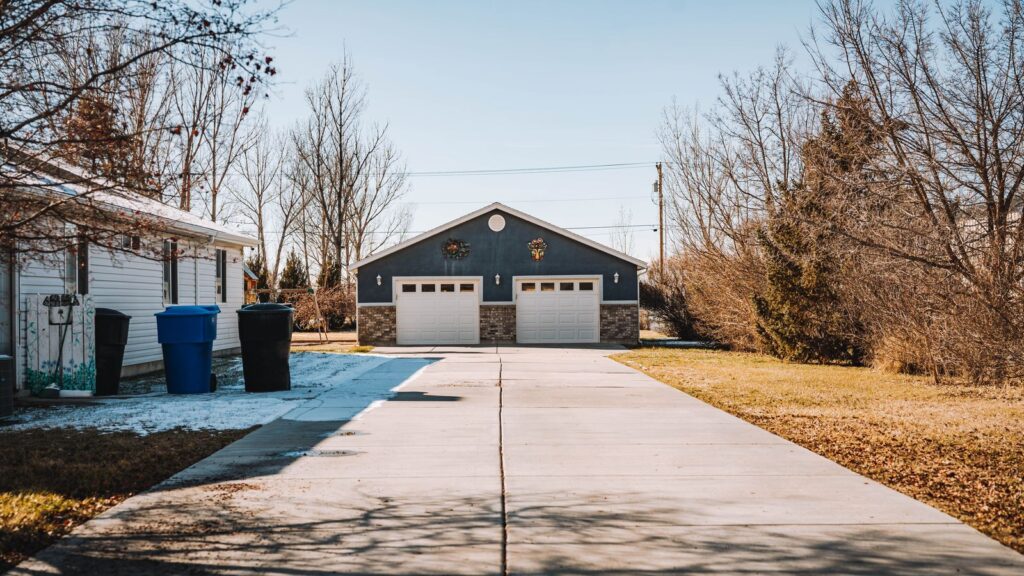
Do more than count the garage doors.
Two doors on the front of a garage tells you almost nothing. I’ve walked buyers into three-stall garages that couldn’t hold a full-size pickup with the tailgate down, and single-stall garages with a deep bay and a workbench that did everything the family needed. The number on the listing is a label. What matters is what actually fits, how you get into the house from it, and whether you can still walk around your vehicle once everything else is in there.
Out here in the small towns east of Lincoln, the garage isn’t bonus space. It’s where the truck, the mower, the tools, the kids’ bikes, and the stuff you use every weekend all live. So I tell buyers to run what I call the garage test before they get emotionally attached.
Start with your actual vehicles
Not a generic car. Yours. Measure your truck or SUV, bumper to bumper, including anything hanging off the back. Then measure the garage, wall to wall and front to back, and note where the door tracks and the overhead opener hang down.
Two things people forget:
- Door height. Older garages in these towns can have shorter openings than newer builds. If you’ve got a lift kit, a rack, or a topper, that number decides everything.
- Depth versus door swing. A garage can be wide enough for two vehicles and still be miserable if you can’t open your door without hitting the wall or the other truck.
Bring a tape measure to the showing. I keep one in my bag. It takes ninety seconds and it settles the argument before it starts.
Then add the equipment
Small-town living comes with equipment. A riding mower if you’ve got a bigger lot. A snowblower. A trailer, maybe. Sometimes a side-by-side. All of that has to go somewhere, and “somewhere” is usually the garage unless there’s an outbuilding.
So walk the space and place things mentally. Mower along the back wall. Trash cans by the service door. Tool chest where you can actually open the drawers. If you run out of room doing that exercise standing in an empty garage, you’ll definitely run out once your life is in it.
If the property has a shed or a detached building, look at it honestly. Is the floor concrete or dirt? Can you get power out there? Is the door wide enough to back a trailer in? A building that looks like storage on paper isn’t storage if you can’t get your equipment through the opening.
Workshop needs are real needs
Plenty of my buyers want a place to work on things. That’s part of why they’re moving out of a Lincoln starter home in the first place. If that’s you, check outlets and the panel. Check whether there’s a 240 line or room to run one. Check the ceiling height for a lift or a long board. Check insulation and whether there’s any heat source, because an uninsulated garage in January is a storage unit, not a shop.
How you get into the house matters more than you think
This is the part nobody looks at during a showing and everybody complains about after closing. Where does the garage door into the house land you? A mudroom with a bench and hooks is a completely different daily experience than stepping straight into the kitchen with a load of groceries and muddy boots.
Also look at steps. Two or three steps up into the house means every grocery trip, every load of laundry, every car seat is a climb. Some people don’t care. Some people care a lot in year three. Know which one you are.
And check whether the garage is attached, detached, or attached but through a breezeway. In a Nebraska winter, that walk matters.
Organization is a design question, not a discipline problem
People blame themselves for a messy garage when the real issue is that the space was never set up to hold what they own. Look for wall space you can actually use. Look at whether there’s attic storage above and a safe way to get up there. Look at where the water heater, furnace, or softener sits, because those eat floor space and you can’t move them.
Verify. Don’t assume.
Listing photos make garages look bigger. Square footage in the remarks is sometimes rounded, sometimes wrong, sometimes measured differently than you’d measure it. If garage space is a real priority for you, we verify it with a tape measure and we write down the numbers. That’s it. That’s the whole trick.
I’ve had buyers walk away from a house they liked because the garage didn’t work, and I’ve had buyers pick a slightly smaller house because the garage did. Both were the right call, because they made the decision with real information instead of a guess.
We don’t have to force it. There will be another one if it’s not right. Love where you live.
If you’re thinking about a move out to Syracuse, Palmyra, Unadilla, Bennet, Weeping Water, Louisville, Murdock, or Elmwood, and you’re trying to figure out whether your stuff and your life actually fit, reach out and let’s talk through it. No commitment. Just a conversation and a plan.
If you’re juggling a sell and a buy at the same time, or eyeing a move to the small towns east of Lincoln, this is exactly what I do all day: See how I work →